

From Kumasi to Europe, from Ragga to Roots Reggae, and from Conscious Lyrics to a Lasting Legacy
By TrapGAD | The Booth Radio Live
There are artistes who follow the sound of the moment, and there are artistes who spend their lives making sure a sound does not disappear.
Osagyefo belongs firmly to the second category.
For decades, the Ghanaian roots reggae and dancehall artiste has remained committed to music that questions, challenges, educates and speaks for ordinary people. From his beginnings in Kumasi as “Ragga” to international recording sessions in the Netherlands, from the stages of reggae festivals to an extraordinary performance with the Ghana Symphony Orchestra, Osagyefo’s journey has been defined by persistence.
But perhaps the most revealing part of his story is not the number of stages he has played or the number of records he has released. It is the reason he continues.
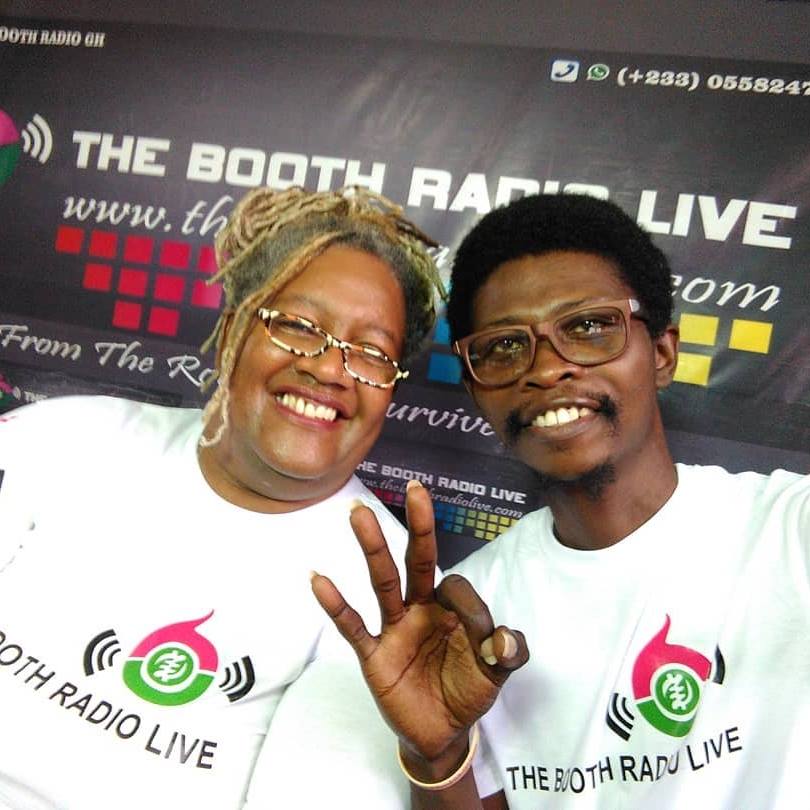
During a special edition of The Booth Radio Live’s Midnight Reggae Vibes, hosted by TrapGAD and co-hosted by Fela TuffSoul, Osagyefo opened up about the journey behind the name, the philosophy behind his music, the struggles facing reggae in Ghana, his international experiences, his albums, and what he believes the future should look like.
The conversation quickly became much bigger than an artist interview.
It became a conversation about identity, consciousness, culture, survival and legacy.
FROM “RAGGA” TO OSAGYEFO
Before there was Osagyefo, there was Ragga.
Growing up in Kumasi, Dennis Afram was influenced by the sounds of the ragga era, particularly artistes such as Shabba Ranks and Buju Banton. He began learning from the music he heard and eventually acquired the name “Ragga” while still in school.
But as his ambitions grew, the name no longer felt sufficient.
After leaving Kumasi for Accra to pursue music professionally, he began thinking more deeply about the identity he wanted his music to represent.
He did not want another name built around the popular “Banton” formula. Instead, he wanted something connected to African identity and liberation.
That search led him to Osagyefo.
For him, the name represented a liberator and freedom fighter—an identity influenced by the ideals he associated with Ghana's first president, Dr. Kwame Nkrumah. More importantly, he believed the purpose of his music was connected to liberation of the mind and speaking for vulnerable and underprivileged people.
That philosophy would become one of the defining characteristics of his career.
Black Star Foundation's own historical account confirms that Dennis Afram began his career under the name Ragga before adopting Osagyefo, whose name it translates as “liberator.”
OSAGYEFO - Oman Chaka Chaka (Official Video)
THE MILITANT YOUTH YEARS
Osagyefo’s story reaches back to the mid-1990s, when the Ghanaian reggae scene operated without the digital infrastructure today's artistes take for granted.
There were no social-media algorithms to discover an artiste overnight. No streaming platforms waiting to distribute a new single globally. No YouTube channel to build an international audience from a bedroom.
You had to put in the work.
Osagyefo recalled visiting the Rastafari community around Accra's Arts Centre with his longtime musical associate DJ Jah Youth. The community had live equipment and regular rehearsals, giving the young artiste an environment where he could learn how to work with a live band.
That experience eventually led to the formation of Militant Youth.
The group became associated with Rastafari celebrations and cultural gatherings, developing a reputation within that community. When Jah Youth later travelled abroad, Osagyefo continued the work with Papa Wisey before eventually becoming part of the musical collective that developed into the All Star Crew/Band.
The transition was significant.
Militant Youth represented the deeply rooted Rastafari side of his musical journey, while the All Star years exposed him to a more commercially oriented performance environment, including clubs and restaurants in Accra.
It was another lesson in the realities of being a working musician.
Black Star Foundation's archival account also places Militant Youth at the heart of Osagyefo's early story, noting that the group was formed with Jah Youth in 1995 and became prominent at Rastafari festivities.
WATCH: OSAGYEFO LIVE AT KUCHOKO ROOTS FESTIVAL 2018
THE DOOR TO EUROPE
A major turning point arrived in 2006.
Osagyefo travelled to the Netherlands through the Black Star Foundation for performances, studio work and rehearsals with international musicians.
The opportunity came after his growing profile in Ghana attracted the attention of Black Star Foundation founder Michelle, who had been following young Ghanaian reggae talents.
One of the moments that strengthened Osagyefo’s profile was his selection to perform at a major Bob Marley tribute concert in Ghana in 2006.
The European trip changed his perspective.
He encountered professional recording environments, better equipment, structured rehearsals, international musicians and a different approach to punctuality and professionalism.
He also discovered that music was not simply about talent.
It was about preparation, collaboration, discipline and understanding the business surrounding the music.
Black Star Foundation records that Osagyefo's first European visit took place in August 2006 and included shows, studio recordings and rehearsals. The organization also documents his collaborations with Tuff Lion and Asher E and says that more than 10 performances were arranged for him during that period.
And then came the recording.
WATCH: OSAGYEFO & Lady K-Wida perform "One Man Woman" at 3fm
“BLAZE FIRE” AND THE INTERNATIONAL EXPERIENCE
In the Netherlands, Osagyefo connected with Tuff Lion, a reggae musician and multi-instrumentalist associated with the Virgin Islands, as well as producer/musician Asher E.
According to Black Star Foundation's account, six songs were recorded with Tuff Lion in a single studio day, while Asher E worked on the remaining material. The result became Blaze Fire, Osagyefo’s debut album, released through the Black Star label in 2007.
For Osagyefo, the experience was transformative.
He described it as an eye-opener that exposed him to professional standards he had not previously encountered at the same level in Ghana.
But perhaps the biggest lesson was collaboration.
The international environment showed him that different musicians could bring different strengths to a project—and that professionalism was not an optional extra.
It was part of the music.
His European experience also allowed him to observe major reggae performers from the audience, something he considers just as important as being on stage.
He watched artistes such as Anthony B, Mykal Rose, Burning Spear and Culture, studying their stagecraft and learning from their performances.
That distinction is important.
Osagyefo understood that sometimes the best education happens when the microphone is not in your hand.
WATCH: OSAGYEFO at African Festival Delft in Europe
LEARNING FROM THE GREATS
Over the years, Osagyefo has shared stages with major reggae names including Alpha Blondy, Tony Rebel, Mutabaruka, Anthony B, Mykal Rose, Steel Pulse and members of the Marley family, among others.
But when asked about those encounters, he did not simply celebrate the names.
He talked about learning.
His philosophy was simple: an artiste cannot know everything immediately. Experience, observation and exposure are essential parts of development.
That mindset helped him treat international festivals not only as performance opportunities but also as classrooms.
He watched.
He studied.
He absorbed.
And he brought those lessons back into his own performances.
THE ARTISTE WHO REFUSED TO ABANDON CONSCIOUS REGGAE
Perhaps the most powerful part of the Midnight Reggae Vibes conversation came when the discussion turned to conscious music.
In an era where artistes are frequently encouraged to follow trends, Osagyefo explained why he never abandoned the social and revolutionary dimension of reggae.
For him, reggae has always been more than rhythm.
It is a vessel.
A vessel for social commentary.
A vessel for justice.
A vessel for liberation.
A vessel for the voices of ordinary people.
He pointed to the influence of Bob Marley, Peter Tosh, Alpha Blondy and other revolutionary reggae figures who used music to confront political and social realities.
That philosophy became visible throughout his catalogue.
Songs such as “Letter to Vanderpuye,” “Parliament,” “Bohobium” and other socially conscious works have addressed issues ranging from demolitions and political accountability to galamsey and social conditions.
His argument was that music should not merely describe the world—it should challenge people to think about changing it.
That conviction has remained central to his identity even as Ghana's musical landscape has shifted dramatically.
WATCH: OSAGYEFO - Stay Far From We (Official Video)
“REALITY CHECK”: MUSIC WITHOUT ILLUSION
If one album captures Osagyefo's philosophy particularly clearly, it is Reality Check.
Released in 2019, the 20-track album featured production collaborations involving names such as Zapp Mallet, Wazumbi, Crownzy Beat and I Bee. Contemporary coverage described the project as a major statement from an artiste regarded as one of the significant interpreters of Ghana's roots reggae and dancehall movement.
But during the interview, Osagyefo explained that the title represented much more than an album name.
It was a worldview.
His central argument was that people must confront reality instead of waiting for magical solutions to life's problems.
In his words, if you want to reach the top of a mountain, you have to climb from the bottom.
That philosophy also explains why the album generated controversy.
Osagyefo challenged ideas he believed encouraged people to escape practical realities rather than confront them. His position was provocative, but deliberately so.
He wanted listeners to think.
Reality Check was therefore not designed merely to entertain. It was designed to provoke consciousness.
And that may be one reason the album remains relevant years after its release.
REGGAE AGAINST THE CURRENT
Another major theme of the interview was Osagyefo’s defence of reggae music in Ghana.
He openly questioned the narrative that reggae and dancehall are dying in Ghana while some of the country's biggest contemporary artistes continue to identify with reggae and dancehall.
For Osagyefo, the problem is not a lack of audience.
The problem is opportunity.
He believes Ghana's reggae fraternity deserves stronger institutional support, festival opportunities, industry recognition and economic participation.
His position is not that Afrobeats, Highlife or any other genre should disappear.
Quite the opposite.
He argues that variety makes a music industry stronger.
If Ghana has reggae artistes and reggae audiences, then the industry should create space for them rather than treating the genre as something that must be replaced.
His argument becomes especially significant when placed against the history of reggae itself.
Ghana has a deep relationship with reggae, and the music has long carried themes of African identity, liberation and social justice.
Osagyefo sees defending reggae not as nostalgia—but as defending an active cultural and economic space.
WATCH: OSAGYEFO - Social Commentator (OFFICIAL VIDEO)
WHEN REGGAE MET THE GHANA SYMPHONY ORCHESTRA
In 2024, Osagyefo reached another remarkable milestone when he performed with the Ghana Symphony Orchestra at the Marcus Mosiah Garvey Foundation Fundraising Gala.
The collaboration was facilitated through the late Naomi Wudase, whom Osagyefo credited with creating the connection.
The performance brought reggae and dancehall together with orchestral instrumentation in a setting rarely seen in Ghana.
He performed original material including “Live the Life You Love” and “Danger,” alongside a rendition of Nana Tuffour's “Odo Ani Nisuo.” Contemporary reports confirmed the performance and its setting at the Gold Coast Restaurant and Cocktail Bar.
Behind the spectacle was a fascinating technical challenge.
Before rehearsals could begin, Osagyefo was asked to provide his music as formal sheet music.
As an artiste who works naturally through musical performance rather than orchestral notation, he needed assistance translating the songs into the written musical language required by the orchestra.
The music was eventually scored, rehearsals followed, and Osagyefo found himself performing with roughly 50 orchestra musicians behind him.
For an artiste who had started from grassroots Rastafari gatherings, the symbolism was enormous.
The roots had entered the orchestra.
“DANGER”: WHEN THE WORLD FEELS UNSAFE
Osagyefo’s 2025 album Danger continued his tradition of using music to respond to the realities surrounding him.
The 10-track roots reggae project includes songs such as “Never Bow,” “Joy and Happiness,” “Homeland Ghana,” “Ghana Reggae,” “Pollution” and “My Sound.” Graphic Showbiz described the album as a return to authentic roots reggae, with its title track reflecting concerns about war, insecurity and instability in the modern world.
During the interview, Osagyefo explained that the album emerged during a period dominated by international tensions, war and threats involving nuclear and ballistic weapons.
The title therefore reflected his perception of a world increasingly filled with uncertainty.
But Danger was not intended simply as an album of fear.
It was a warning.
It was an appeal for consciousness.
And it was another example of his belief that reggae has a responsibility to speak about what is happening around us.
Songs such as “Never Bow” carry the spirit of resistance, while “Joy and Happiness” approaches happiness as something practical and internal rather than something that can simply be summoned through wishful thinking.
Again, the message is unmistakably Osagyefo:
Think. Observe. Understand. Act.
OSAGYEFO - Homeland Ghana (Official Video)
THE SIMPLE ENTERTAINER
Away from the politics and philosophy, there is another side of Osagyefo.
The man behind the microphone describes himself as “The Simple Entertainer.”
That description is more than branding.
During the interview, he explained that when he leaves the stage, he does not want people treating him as though he is above them.
For Osagyefo, respect must work both ways.
He spoke about the importance of character, humility and how an artiste behaves when the performance is over.
The stage can create the illusion of importance.
But fame, in his view, should never become an excuse for arrogance.
That may explain why the phrase “Simple Entertainer” fits him so naturally.
The artiste can command a stage without needing to demand special treatment away from it.
WATCH: OSAGYEFO - Simple Entertainer (Official Music Video)
THE MUSICIAN WHO WOULD NOT CHOOSE ONLY THREE LEGENDS
Asked to choose three reggae legends for a dream dinner, Osagyefo refused to reduce his influences to three names.
He mentioned artistes including Don Carlos, Sizzla, Tony B and Capleton, but the answer quickly became something deeper.
For him, the ideal dinner would not simply be about celebrity.
It would be about reasoning.
Conversation about Africa.
Conversation about liberation.
Conversation about humanity.
And, importantly, conversation about how people can put food on the table.
That response revealed something fundamental about Osagyefo's worldview: consciousness, in his mind, cannot exist separately from everyday survival.
Big ideas mean little if they cannot improve human lives.
THE AWARD THAT CONFIRMED THE JOURNEY
In 2025, Osagyefo received recognition from the Marcus Mosiah Garvey Foundation for his contribution to African unity and consciousness through music.
The recognition mattered to him because it represented something beyond popularity.
He viewed it as evidence that people had been watching the work.
That was particularly meaningful because he has often felt that Ghana's mainstream industry does not always recognise artistes based purely on consistency or contribution.
Yet recognition from organisations focused on African consciousness and cultural development gave him renewed motivation.
Graphic Showbiz reported that Osagyefo was honoured at the Foundation's August 2025 awards gala for using his music to promote African unity and consciousness.
The award therefore became another chapter in the story.
Not the destination.
The motivation to continue.
WATCH: Osagyefo honored with an award by the Marcus Garvey Foundation
THE QUICK-FIRE MOMENT
Then came the lighter side of the conversation.
Roots reggae or dancehall?
Osagyefo did not hesitate.
Roots reggae.
Live band or studio recording?
He turned the question into a lesson, explaining that recording and performance are different experiences—but when it comes to performance, he will choose the live band.
Kumasi or Accra?
That one was harder.
His answer was essentially both.
Kumasi is where his roots began. Accra became the centre of his professional reggae journey.
And when asked to choose between a deep conscious song and a big crowd anthem, his philosophy once again surfaced:
The crowd anthem may move the crowd tonight.
But when the crowd goes home and reality begins again, people still need music that can uplift, calm and give them something to hold on to.
For Osagyefo, conscious music has a longer life than trends.
WHAT COMES NEXT?
Perhaps the biggest revelation of the interview came at the end.
Osagyefo is not finished.
Not even close.
He revealed that his next project is Rough Style EP, a project that deliberately explores the party side of his artistry through dancehall.
Songs including “Party Turn Up,” “Rough Style” and “Stay Far From Me” represent a different dimension of the artiste audiences have traditionally associated with conscious roots reggae.
But Osagyefo made it clear that Rough Style is not a permanent departure from his core identity.
He described it as a moment to put people in a party mood.
After that comes New Memories.
The project is already completed and is planned for release in early 2027. Osagyefo described it as a 10-track album with a strong emphasis on authentic instrumentation and a sound he believes will take his music to another level.
So the journey continues.
THE LEGACY IS STILL BEING WRITTEN
There is a powerful irony in Osagyefo's story.
He spent years defending reggae while people told him the genre was losing relevance.
Yet he kept recording.
He kept performing.
He kept travelling.
He kept speaking.
He kept experimenting.
He kept defending the culture.
And reggae remained.
His journey—from Ragga in Kumasi, to Militant Youth, to the All Star years, to Europe, Blaze Fire, Reality Check, Serious Times and Danger—is a record of an artiste who refused to allow changing trends to dictate his identity.
His music has questioned political systems, confronted social realities, celebrated Ghana, explored African consciousness and challenged listeners to think beyond easy answers.
But perhaps his greatest contribution is the consistency.
In an industry where attention can disappear quickly, Osagyefo has chosen longevity over convenience.
He has chosen message over fashion.
He has chosen roots over abandonment.
And he has chosen to believe that reggae still has something important to say.
As the interview drew to a close, Osagyefo's next chapter was already taking shape: Rough Style EP, followed by New Memories in 2027.
The music continues.
The message continues.
And the legacy?
It is still being written.
OSAGYEFO — THE SIMPLE ENTERTAINER
Ghanaian Roots Reggae & Dancehall Artiste
From Kumasi to Europe.
From Ragga to Osagyefo.
From grassroots reggae to the symphony orchestra.
From conscious lyrics to a new generation.
Authentic roots. Conscious lyrics. One enduring journey.
WATCH FULL INTERVIEW BELOW:
MIDNIGHT REGGAE VIBES
This special artist interview was hosted by TrapGAD and co-hosted by Fela TuffSoul on The Booth Radio Live’s Midnight Reggae Vibes show.
Proudly sponsored by:
Team 4K Shooterz • Yardie Session • TuffBuzz Entertainment • Victory Herbal Hair Booster
The Booth Radio Live — From The Roots, We Survive.


0 Comments